
Support would fall from 90% to 85%, 70% to 65% and 40% to 35% in April 2027. That leaves 8,450 households paying more, 2,393 less. Consultation to 14 October.
Northumberland County Council wants to cut the council tax discount for three of its five support bands from April 2027. On the council’s own figures, 8,450 households would pay more and 2,393 would pay less.
Cabinet approved a consultation on the change on Tuesday 8 September. The scheme covers working age residents only. Pension age support is set nationally and is not affected.
What is proposed
The council has run an income banded scheme since April 2026. Your discount depends on your household income and who lives with you. Three of those bands would be trimmed by five percentage points (Council Tax Support Scheme Review, Cabinet, 8 September 2026).
| Band | Discount now | Proposed from April 2027 |
|---|---|---|
| 1 | 100% | 100% |
| 2 | 90% | 85% |
| 3 | 70% | 65% |
| 4 | 40% | 35% |
| 5 | 20% | 20% |
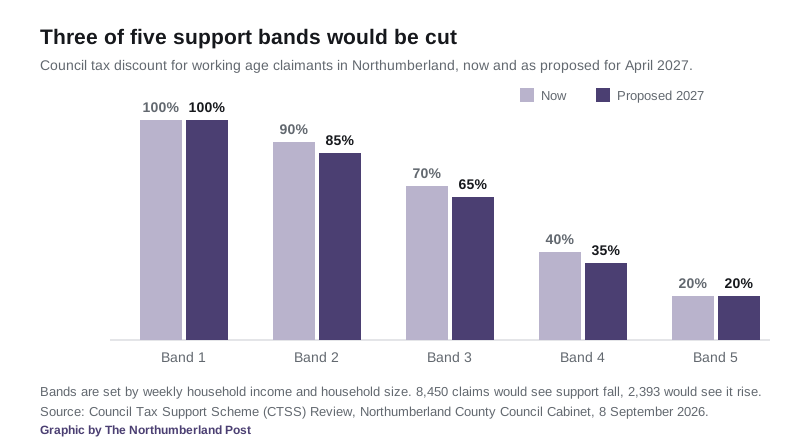
The 100% band is deliberately untouched. The report says keeping full support for the lowest incomes was judged “desirable”, partly because the council then has no council tax to collect from those households at all.
Which band you are in
Bands are set by weekly household income. These are the current thresholds, published with the consultation questions (Appendix B, Consultation Questions).
| Discount | Single person | Couple | Family, 1 child | Family, 2+ children |
|---|---|---|---|---|
| Band 1, 100% | £0 to £105.00 | £0 to £155.00 | £0 to £245.00 | £0 to £335.00 |
| Band 2, 90% | £105.01 to £155.00 | £155.01 to £210.00 | £245.01 to £290.00 | £335.01 to £355.00 |
| Band 3, 70% | £155.01 to £205.00 | £210.01 to £265.00 | £290.01 to £365.00 | £355.01 to £405.00 |
| Band 4, 40% | £205.01 to £315.00 | £265.01 to £365.00 | £365.01 to £445.00 | £405.01 to £495.00 |
| Band 5, 20% | £315.01 to £405.00 | £365.01 to £465.00 | £445.01 to £545.00 | £495.01 to £605.00 |
| Band 6, 0% | £405.01 or more | £465.01 or more | £545.01 or more | £605.01 or more |
Around 24,200 council taxpayers in Northumberland receive support. About 14,500 of them are of working age. The scheme costs roughly £27m a year, of which about £14.5m goes to working age households. The proposed scheme is costed at about £26.9m.
Why the council is doing it
The change is not being made to save new money. It is being made to pay for fixing a mistake.
When the banded scheme started in April 2026, officers found what the report calls an “unexpected anomaly”. Claimants receiving Carer’s Allowance or Employment and Support Allowance as separate payments were getting less support than people on the same weekly income who received those allowances inside their Universal Credit. The cause was the treatment of the housing element.
The council reassessed 1,794 cases. Of those, 1,488 saw a change in the council tax due for the year. Enforcement action for non payment was paused for affected households while the work was done, and all cases were reassessed by 30 June 2026.
The proposed fix is to disregard 100% of the housing element of Universal Credit for everyone. That costs money. The cross party working group that considered it accepted that extra budget “was not a viable option”, so the cost is offset by reducing bands 2, 3 and 4.
Who gains and who loses
Both groups are real, and the council has counted them.
8,450 claims would see support fall. Most losses are small but weekly:
- 3,909 households would lose between £1.26 and £1.50 a week
- 2,362 would lose between £1.51 and £2.00
- 1,731 would lose between £1.01 and £1.25
- 234 would lose more than £2.00, with the largest losses between £3.51 and £4.50 a week
Single claimants make up 4,896 of those 8,450.
2,393 claims would see support rise, because of the housing element disregard. Those gains are larger:
- 820 would gain between £6.01 and £7.00 a week
- 464 would gain between £3.01 and £4.00
- 356 would gain between £5.01 and £6.00
- 30 would gain between £11.01 and £20.00
A further 54 claims on small amounts would stop qualifying altogether under the proposed rules.
The hardship fund has barely been used
When Council approved the banded scheme in January, it created a Hardship Fund of £1.000m for households hit hardest. It is a one off sum, not a recurring budget line.
As at 31 July 2026, the council had processed 511 claims against it, with 27 still being assessed. It had made 28 awards, worth £10,426 in total. The report attributes the low take up to the criteria set for the fund.
The working group wants any unspent money kept for future years, and may reconvene in the autumn to look again at how it is allocated, including suggestions from Citizens Advice. The report is clear that no replenishment is built into the budget or the medium term financial plan, and that the future of the money is “a wider political decision”.
The carers exemption Council asked for is not happening
When the scheme was approved on 14 January 2026, councillors attached a condition. It said households containing a severely disabled adult or a recognised unpaid carer should be exempt from reductions in maximum support, and that a report should come back to Full Council on the financial and social impact.
The cross party working group met on 19 August 2026 to consider it. Its conclusion was that while the intention was acknowledged, “the practical implications of implementing such a scheme, along with the potential financial impact, meant that it was not feasible to introduce this at the present time”.
The group was chaired by Councillor Nick Oliver, the Cabinet Member for Finance and Value for Money, with Councillors David Swinhoe, Caroline Ball, Patrick Lambert and Isabel Hunter.
What it means for you
If you receive Council Tax Support and you are of working age, find your income band in the table above. If you are in band 2, 3 or 4, your bill from April 2027 would go up, before any change in the council tax rate itself. If you receive Carer’s Allowance or ESA paid separately from Universal Credit, you may be among those who gain.
The council stresses that no direct comparison is possible, because the overall council tax level for 2027-28 has not been set and household circumstances change.
The consultation asks seven questions, one on each proposed change, each with space to disagree and suggest an alternative. The dates that matter:
- the consultation runs until 14 October 2026, according to the Cabinet report
- an Extraordinary Cabinet meeting considers the final proposal on 27 October 2026
- Full Council votes on the scheme on 4 November 2026
- a full Equality Impact Assessment will be done before that vote
- if approved, the scheme starts 1 April 2027
One practical caveat. As at 10 September, the council had not yet listed this consultation on its consultations and events page, which was last updated in July. If you want to respond, that page and the Council Tax Support pages are where it is expected to appear.
If you are struggling with a bill now rather than in 2027, the Council Tax Exceptional Hardship route is open on the council’s Council Tax Support pages. Our guide to council tax bands in Northumberland explains how the underlying charge is worked out.
Have your say