
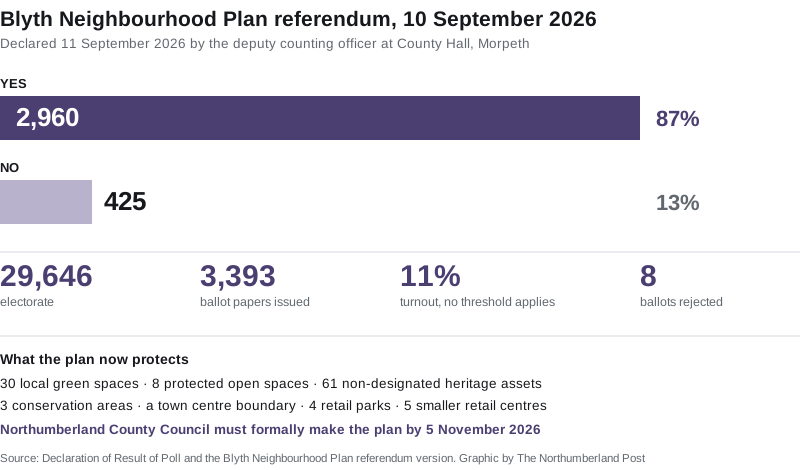
Blyth voted 2,960 to 425 for its neighbourhood plan on an 11% turnout. It is already part of planning law, and 30 green spaces now have protection.
Blyth has voted to give itself a say over planning applications. The referendum held on Thursday 10 September returned 2,960 votes for Yes and 425 for No, a margin of 87% to 13%. The result was declared on Friday 11 September by Lynsey Denyer, the deputy counting officer, at County Hall in Morpeth.
Turnout was 11%. Of an electorate of 29,646, some 3,393 ballot papers were issued, and eight of those were rejected. Three were rejected for voting for more answers than required and five were unmarked or void for uncertainty.
The plan is already law, before anyone adopts it
This is the part that tends to get lost. A neighbourhood plan does not wait for a council vote to take effect.
Government planning guidance is explicit: a neighbourhood plan “comes into force as part of the statutory development plan once it has been approved at referendum” (Planning Practice Guidance, paragraph 064). Northumberland County Council must still formally make the plan, and it has eight weeks from the referendum to do it. That deadline falls on 5 November 2026.
Until then, and after, planning officers determining an application inside Blyth parish have to decide it in line with the plan unless material considerations indicate otherwise. Blyth Town Council, which wrote the plan, put the same point more plainly in its announcement of the result: the county council “is now required to ‘make’ (adopt) the Neighbourhood Plan within a defined period”.
What the Yes vote actually protects
The referendum version of the plan runs from 2026 to 2036 and carries seven policies. None of them allocates land for housing. They cover shops, heritage and open space, and the open space policies are the ones with real force.
- 30 local green spaces (Policy 6). National policy rules out development on a designated local green space other than in very special circumstances. Ten of the 30 are allotment sites, from Bolam Avenue to 20th Avenue. The rest include Newsham Pond, Ridley Park, Halfpenny Woods, Meggies Burn, Croft Park, Cowpen Recreation Ground, Isabella Heap, Isabella Field, New Delaval Park, South Beach and Blyth Links and Beach Gardens.
- 8 protected open spaces (Policy 7), safeguarded under Local Plan policy INF 5: Blyth Golf Course, Blyth Sports Centre, both Bede Academy playing fields, Dene View Drive, Chestnut Avenue, land north of South Newsham Road, and the play area at Crawford Street and Millfield Gardens.
- 61 non-designated heritage assets (Policy 5), a list that runs from the Beach Bandstand and Bedlington Viaduct to the lifeboat station on Quay Road, the old Customs House on Ridley Street and several of the town’s pubs, among them the Steamboat Inn on Bridge Street and the Windmill on Cowpen Road.
- Three conservation areas with their own policies (Policies 2 to 4): Bondicar Terrace, Blyth Central and Blyth Heritage.
- A town centre boundary and key shopping frontages (Policy 1), plus four named retail parks and five smaller retail centres, all of them mapped.
The town council assessed 102 sites across Blyth before settling on the green space lists.
The result is not yet on the county council’s own page
When we checked on Saturday 13 September, three days after the poll, Northumberland County Council’s neighbourhood planning page still carried the heading “Blyth (Referendum to be held 10 September 2026)” and the Notice of Poll, with no declaration of result. The council’s news page carried no item on it either.
The declaration itself is published. It is on Blyth Town Council’s website as a one page Declaration of Result of Poll, printed and published by the counting officer at County Hall. That document, not a summary of it, is the record.
What it means for you
If you are objecting to an application in Blyth, cite the plan. From 10 September the plan is part of the development plan for the parish. An objection that names the specific policy and the specific designation, for example that a site is LGS14 Newsham Pond under Policy 6, carries more weight than a general one.
If you own or are buying land on one of those lists, the position has changed. A local green space designation is close to a development bar. A protected open space designation is a strong presumption. Both are now in force.
The policies map is the document to open. Whether a particular field, parade or frontage is inside or outside a designation is decided by the map rather than the text. It is published alongside the plan on the county council’s neighbourhood planning page.
11% turnout does not weaken it. There is no turnout threshold in a neighbourhood plan referendum. The only test is that more than half of those voting vote Yes, and 87% did.
What comes next. The council has until 5 November to make the plan. We covered the vote itself in August, including what was on the ballot paper and how the deadlines fell. Other plans moving across the county, including Alnwick and Denwick and the county’s own Local Plan review, are on our Northumberland planning news page.
Sources
- Declaration of Result of Poll, Blyth Neighbourhood Planning Referendum, signed by Lynsey Denyer, deputy counting officer, dated Friday 11 September 2026, for the vote totals, the rejected ballots by category, the electorate, the ballot papers issued and the turnout.
- Blyth Town Council: Blyth Neighbourhood Plan approved by residents (11 September 2026) for the announcement and the making duty.
- Blyth Neighbourhood Plan: Referendum Version for the seven policies, the 30 local green spaces, the 8 protected open spaces, the 61 non-designated heritage assets, the retail designations and the 102 sites assessed.
- Planning Practice Guidance: neighbourhood planning, paragraph 064 for a plan coming into force as part of the development plan at referendum, and the eight week deadline for the local planning authority to make it.
- Northumberland County Council: neighbourhood plans, checked 13 September 2026, for the absence of a published result.
Have your say